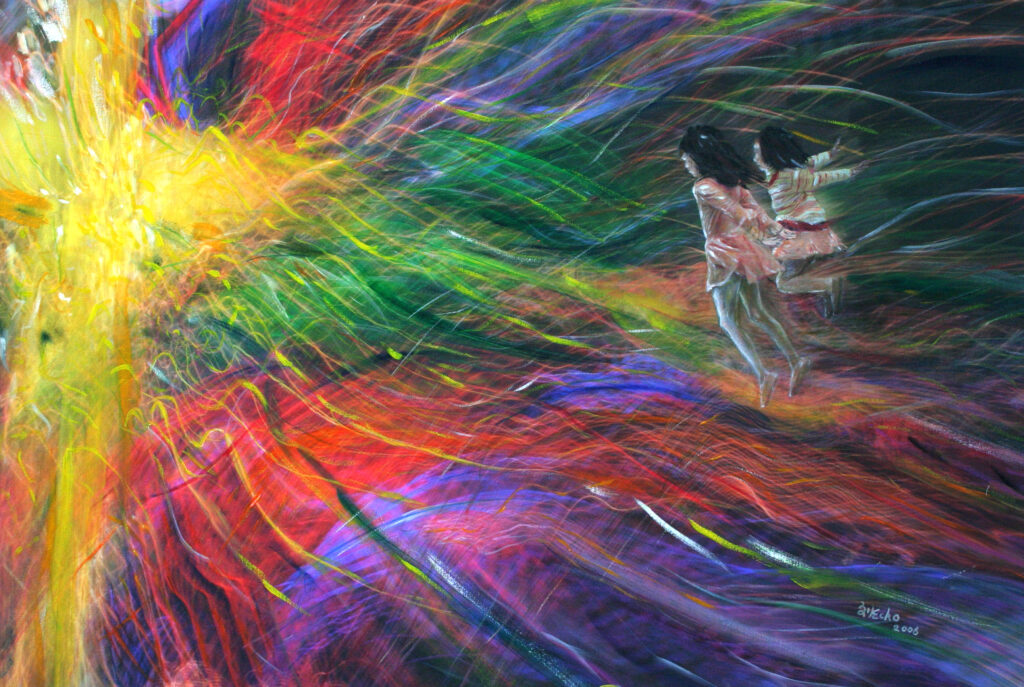
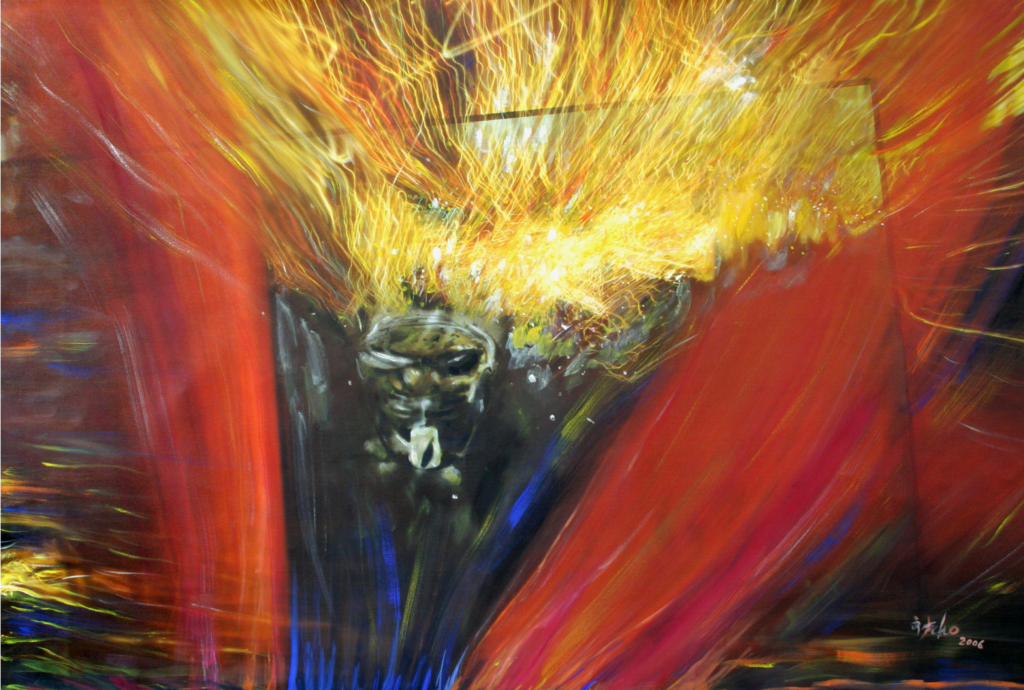
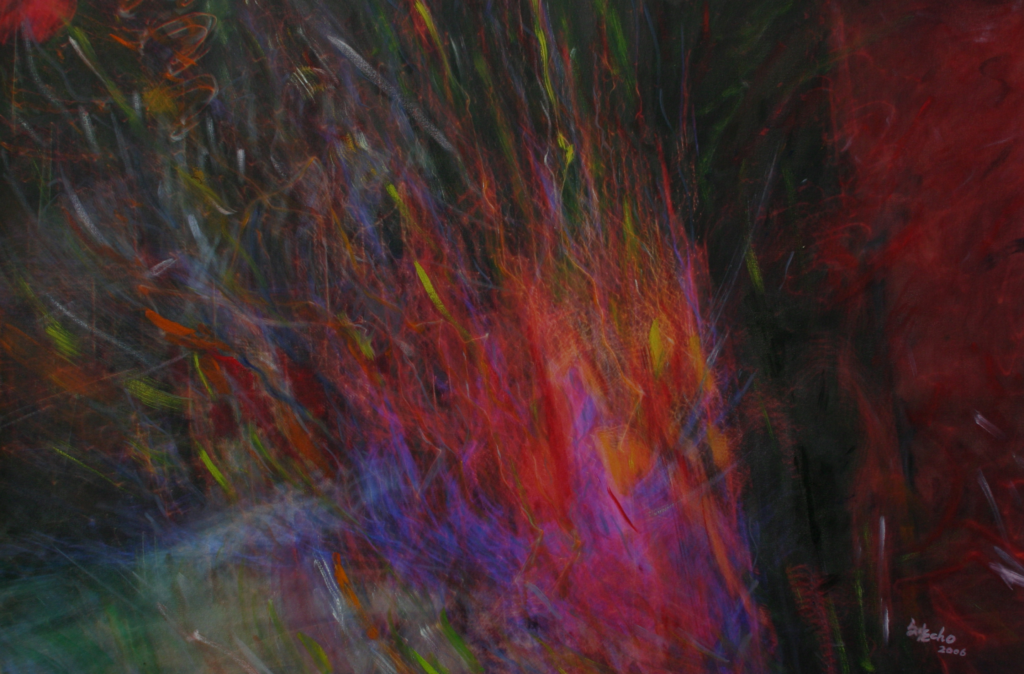
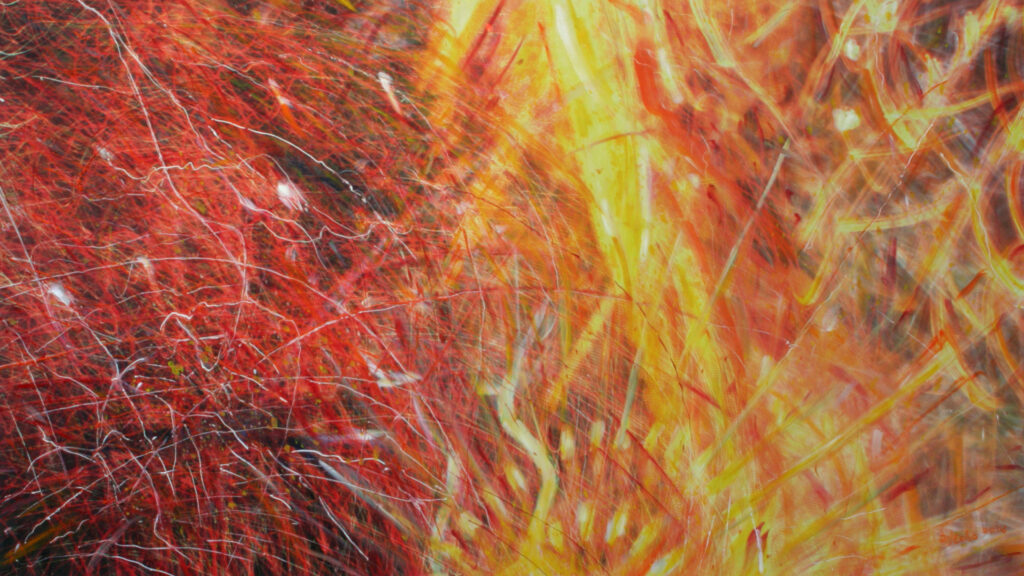
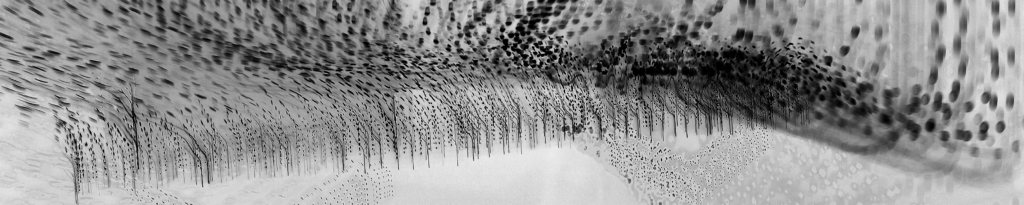
“With his Light Drawings Echo Lew has invented a conceptually uncomplicated but visually dense and absorbing kind of art – and has done so by setting himself down and simply investigating and working at a point past which others insist on pushing on. Lew’s calligraphic photo-prints – perhaps we could call them “calligraphs” – relate to much contemporary abstraction, photographic not least; but they do not succumb to the experimental excess or intellectualization that freights so much related work and renders it either thickly impenetrable or weakly conceived or formed.”
Peter Frank


Biography of Echo Lew
The Beginning

Echo Lew was born in Taiwan and moved to the United States in 1983. He is an international contemporary artist based in Los Angeles, California. His artworks are featured in galleries and private collections throughout the United States, Japan, Italy, France, Germany, Taiwan, and China.
As a self-taught artist, Echo’s early influences drew from early 20th-century aesthetics, but his practice evolved into a distinctly contemporary visual language. He is the inventor of “Light Drawing”. A technique using long-exposure photography to capture his spontaneous “drawing in space” and “dancing with lights.” This signature approach has become a defining element of his contribution to contemporary art.


Artist’s Statement From Echo Lew
“Light Drawings”
After several hours of preparation, I use just a single shot to complete each image. During an exposure time of approximately one minute, I manipulate lights in front of the camera to create “Light Drawings.” Sometimes I invert the positive image to a negative one on a computer but otherwise the “Light Drawings” are not manipulated. Sometimes I put the same positive and negative images side-by-side in the finished piece.
I have been drawing with traditional mediums for twenty-eight years. I used oil painting to explore the effects of light in a 2006 solo exhibition, “See the Light,” at the Little Tokyo Cultural Center, partnered with Helen Keller International. I became curious about the effects of lights in motion. Could this become the basis of a new kind of drawing? I experimented with cameras and lights until I was able to spontaneously tap into decades of drawing experience while the camera’s shutter was open, bringing life to a series of “Light Drawings.”
The technique originated in 1914 when scientists Frank and Lillian Gilbreth used small lights and an open shutter to track the motions of factory workers. My light drawings are inspired by Jackson Pollock and Cy Twombly whose paintings are composed with spontaneous actions, performances traced in time.
In my Zen Buddhist meditation practice, the lights bend like a reed in the breeze, or soar freely as a bird above a cliff, thousands of lights dancing in my mind. The inner world is clean, clear and full of fresh air. Thousands of lights move as a wave. The secrets of the universe are revealed.
Music, especially classical symphony, also shapes these visions. I draw the feelings the music brings forth, the expansive sense of flying over mountains, rivers, and oceans.
I have been an abstract painter for many years, concerned with line, shape, composition and concept. Digital photography allows me to expand creatively while using an ultra-contemporary medium with limitless potential.
Art for me is an experimental adventure, a profound form of play.


Anise Stevens Art
Trebuchet
November 12th, 2015.
The son of two Taiwanese farmers, Echo Lew grew up alongside seven siblings, all of whom farmed his parents’ small acreage of land throughout their youth.
Then, after the civil war (when the Republic of China was reduced from the mainland to Taiwan), Lew was given the opportunity to obtain an education, an incentive offered by the government to boost industrialization.
When given the chance to attend college, Lew followed his parents’ advice. He majored in navigation for the Merchant Marine although he desired to study fine art and admits that he “skipped most his…classes to audit art courses, where he spent more time in the studio than students who were taking that degree,” as offered by Robert Seitz.
Upon graduation, however, Lew quickly realized that “life at sea as a navigator for the Merchant Marine” offered him experiences he may never had otherwise. Not only did he visit eleven new countries, but he used his shore leaves to explore as many art museums as he could worldwide.‘Wind’ Copyright © Echo Lew 2013
Lew eventually emigrated to the United States and in doing so undertook an ambitious path. The confidence and knowhow he’d gained at sea provided him with the drive to begin a design business and thus invent more than 50 patents for new bodies of ballpoint pens. While he attributes his success in this field to his studies as a student of art, it remains evident that his parents’ urging for practicality also played a considerable role in the evolution of his innovative endeavors.
After working with traditional media for nearly thirty years, Lew’s curiosity about the effects of light in motion prompted an investigation with experimental photography. Not only did this lead him to “spontaneously tap into decades of drawing experience while [his] camera’s shutter was open,” as articulated by Lew himself, but it provided him with a means to express his experiences as both an inventor and a fine artist.
Interestingly, Lew’s recent work holds a history that is equally based in aesthetics as well as utility. Some of the first artists to experiment with light and the suspended opening of the camera shutter include Man Ray and Picasso, in addition to the Futurists. While their works are undeniably influential to Lew’s practice, as equally relevant are the motion studies that Frank and Lillain Gilbeth conducted during the early 20th for the sole purpose of industry.
While various influences have helped to shape Lew’s work, his “light drawings” are nothing short of phenomenal. Truly unique, they each embody a cohesive fluidity that emit an intensity comparable to that of a ocean’s crashing wave while, at the same time, a graceless ease emblematic of a Baroque symphonic composition.
光影變幻:劉白 (Echo Lew) 的攝影作品
Echo Lew近期的作品兼具美學與實用性,創作歷程也同樣多采多姿。
2015年11月12日 Anise Stevens Art
劉白出生於台灣,父母都是農夫。他與七個兄弟姊妹一起長大,從小就幫父母耕種他們那小小的土地。
內戰結束後(中華民國從大陸縮減至台灣),劉白獲得了接受教育的機會。這是政府為了促進工業化而提供的一項誘因。
在獲得大學入學機會後,劉白聽從了父母的建議。他選擇了航海專業,想成為商船海員。儘管他渴望學習美術,但他坦言自己“經常逃課去旁聽藝術課,在工作室裡待的時間比那些攻讀藝術學位的學生還要長”,正如Robert Seitz所說。
然而,畢業後,盧很快意識到,「作為商船隊領航員的海上生活」為他提供了許多他原本可能無法獲得的經歷。他不僅遊歷了十一個新國家,也利用岸上休假盡可能參觀世界各地的藝術博物館。 《風》版權所有 © Echo Lew 2013
劉白最終移民到美國,並由此開啟了一段雄心勃勃的旅程。他在海上累積的自信和經驗,促使他創辦了一家設計公司,並因此獲得了50多項原子筆筆身專利。雖然他將自己在這一領域的成功歸功於他作為藝術學生的學習,但父母對務實的督促也顯然在他創新事業的發展中發揮了重要作用。
在從事傳統媒體工作近三十年後,劉白對運動光線效果的好奇心促使他開始探索實驗攝影。正如劉白本人所言,這不僅讓他“在相機快門開啟時,自發地運用了數十年的繪畫經驗”,而且還為他提供了一種表達自身作為發明家和藝術家雙重身份的途徑。
有趣的是,劉白近期的作品兼具美學與實用性。最早嘗試利用光線和相機快門開啟狀態進行創作的藝術家包括曼·雷、畢卡索以及未來主義者。他們的作品無疑對劉白的創作實踐產生了深遠的影響,而弗蘭克·吉爾貝斯和莉蓮·吉爾貝斯在20世紀初為工業用途而進行的運動研究也同樣具有重要意義。
儘管多種因素共同塑造了劉白的作品,但他的「光繪」作品堪稱驚艷絕倫。它們獨一無二,每一首都體現出一種渾然一體的流暢感,散發出如同海浪拍岸般的磅礴氣勢,同時又兼具巴洛克交響樂作品特有的那種渾然天成的優雅。
圖片:版權所有 © Echo Lew 2013